AI 3D for Ecommerce: Let Customers Spin Your Products and Buy in 3D
Forget static photos. With AI 3D for e-commerce, you turn a single product image into a fully interactive 3D model — ready for web, AR, and configurators — in minutes, not weeks.
Shop by role
Where teams feel the pain — and where AI 3D pays for itself
Four personas, one common problem: product images that don't show the whole story.
Furniture & home goods
Customers hesitate on sofas and lamps because a photo can't show scale or back detail. One 3D model from image turns browsing into "add to cart". Turn any product photo into a rotatable 3D model and watch dwell time climb.
Footwear & apparel
Sizes and fit anxiety drive returns. An interactive sole-and-upper view cuts the guesswork. Game-ready AI asset pipelines prove how fast a single image becomes a usable mesh.
Beauty & cosmetics
Bottles and compacts need a tactile feel. 3D spins show the cap, the pump, the refill — without a studio shoot. A quick text-to-3D generation covers seasonal SKUs.
Electronics & gadgets
Ports, buttons, and thickness matter. A 360° view answers questions before support tickets. For complex rigs, real-time 3D model for Unity workflows keep the quality bar high.
Jewelry & accessories
Reflection and sparkle are the selling point. AI 3D captures the facets, while the metal ring and clasp get their own inspectable geometry.
Automotive parts
Fitment is everything. A rotatable bracket or hose shows mounting points in a way a parts diagram never could.
See the difference
One image in — a full product experience out
Feed it a studio shot. Get back a model your customers can spin, zoom, and place in their own space.
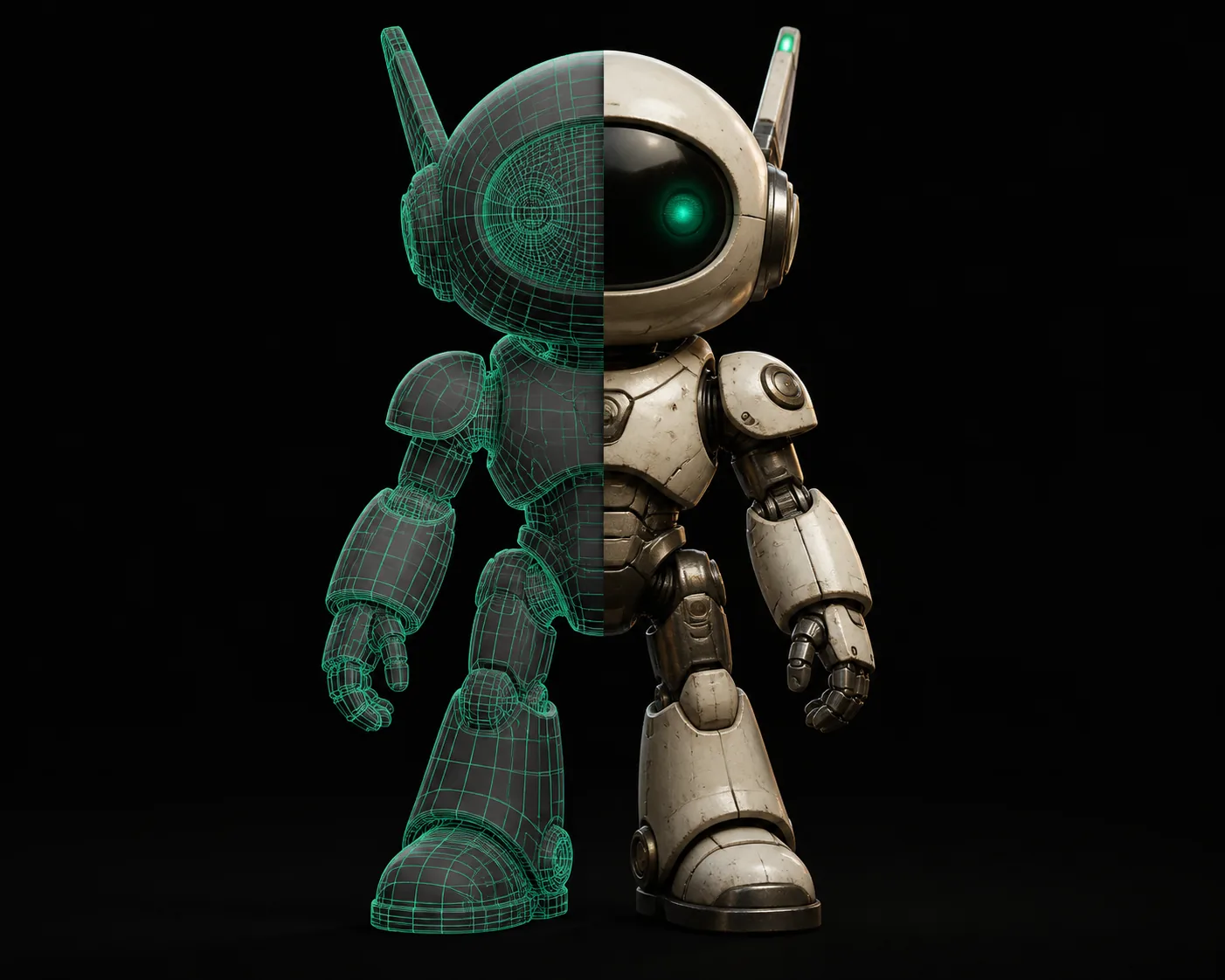
The same source shot, processed through an AI 3D pipeline. Customers can drag to rotate, pinch to zoom, and inspect the backrest from every angle.
Estimate your ROI
How much time and money does AI 3D save you?
Traditional cost
$15,000
per month
AI 3D cost
$300
per month
Time saved
25 h
per week
Assumes manual 3D at $150/model vs. AI at $3/model, 4 minutes of artist time per AI model.
Pick your path
When to generate in-house, outsource, or go fully automated
Low volume, high detail
When: Under 20 SKUs a month, hero products.
Then: Use a hybrid AI + manual cleanup.
Why: You need microscopic fidelity for a flagship item, and a human touch is affordable at this scale.
High volume, standard products
When: 100+ SKUs, apparel, parts, repeatable shapes.
Then: Fully automated pipeline. Batch upload product shots, schedule nightly generation.
Why: The cost per model drops to near zero, and consistency across the entire catalog matters more than hero quality.
Complex or configurable items
When: Furniture with fabric options, electronics with ports.
Then: Generate a base mesh, then use AI to swap materials / variants.
Why: You get a rapid multi-variant catalog story, not a one-off model.
From photo to publish
How the AI 3D for e-commerce workflow works
Upload a product shot
Use a clean image with a plain background. Any smartphone photo works — no studio required.
AI generates the mesh
Our model predicts geometry, texture, and lighting. You get a GLB/GLTF file in minutes, not days.
Review & refine
Check the model in the viewer. Make a quick edit if needed — change materials or fix a glitch.
Publish anywhere
Drop the 3D model into your product page, AR Quick Look, or a 3D configurator. No plugin needed.
Fair questions
AI 3D for e-commerce — what stores actually ask
How accurate is the 3D model compared to the original product?
Modern AI 3D pipelines hold up impressively well. For hard-surface items — furniture, gadgets, bottles — the geometry captures proportions and details to within a few percent. Texture fidelity is the weak spot, especially on shiny or transparent materials. You get a model that's perfect for web viewing and AR; for ultra-photorealistic renders, you might add a quick texture pass.
Will AI 3D slow down my online store?
A well-optimized GLB file loads in about 100–300ms on a decent connection. If you're worried about page speed, serve the 3D model as a progressive enhancement — the static image loads first, and the 3D viewer swaps in on interaction. That way, AI 3D never hurts your Core Web Vitals.
Can I use AI 3D for products I already sell on Amazon or Shopify?
Absolutely. You export the model as GLB/USDZ, which both Shopify's 3D viewer and Amazon's AR view support. The same source can feed your web catalog, an AR filter, and a social post. One upstream 3D asset, many distribution channels.